For my A-Level Media Studies, I will be put into a group of 4 and create a five minute long video. Being five minutes will put the film into the "Short" Category. To distribute the film, posters will be made, a film review will be written and a marketing plan devised. However, before all that I must fund out how to define a "Short", and find out what I must do to make it the best it can be.
Tuesday, 30 March 2010

Monday, 29 March 2010
What makes a good short film - Research
The following notes are from
Marilyn Milgrom, script consultant Published from Times Online February 11, 2008 http://entertainment.timesonline.co.uk/tol/arts_and_entertainment/film/article3336775.ece?token=null&offset=0&page=1 Info found 19th October
The Character & the Problem- The most important questions to ask yourself when you begin to develop your story are:
- Who is the main character?
- What is their problem?
- How will the audience recognize the problem?
- Are the stakes high enough?
- Am I telling the story from the best point of view?
- A want
- A need
- An obligation
Making Problems Manifest to the AudienceThe way in which you turn a character’s inner problem into the heart of your film and make sure that the audience can SEE it is one of the most important ways that you can demonstrate your skill as a filmmaker and not just as a story-teller. When we’re reading books we can be inside a character’s head but when we’re watching films we need to see characters DOING things that show us what they are thinking and feeling.
Are the Stakes High Enough?
Ensuring that there is something at stake in the story means that the audience can understand what the character stands to lose if they do not solve their problem. If the story hinges around a life or death situation then it is clear what is at stake but if it is simply that the car breaks down think about how you set the film up so that the audience knows why it really matters that the character completes this particular journey.
Am I Telling the Story from the Best Point of View?
Think about the story of Cinderella and imagine if you told it with one of the ugly sisters as the main character. You could still make a good story but it would not have a happy ending.
What Does My Story Mean?You probably don’t set out to write a film with a moral or even with a conscious awareness of what your story means but every story communicates some meaning to the audience.
To summarize so far
A good short film needs a story in which something happens that has a noticeable effect on the main character. All successful short films focus on one moment/event. That moment is likely to be: one of universal significance a moment that is of significance to the protagonist (whether s/he knows it at the time) one that produces a situation in which the stakes are high for the protagonist.
Reflection upon my research on our original film idea.
The main Character is: Ashleigh
Ashleigh Is a 8 years old, she is a child from a broken home, her mother has recently left the family which has left her father in a bit of a state, not knowing how to raise his child, his ignorance takes over, he then neglects Ashleigh leaving her older brother to look after her. Ashleigh’s older brother is around 18 and is more adjusted as he has realized his mother isn’t coming back and had longer to get used to that idea, as he experienced his parents difficulties growing up. Being a teenager Jon is distracted with his own life and work to realize that Ashleigh is being neglected by her father choosing to believe everything is okay. Which is why he is severely shocked when he finds that her father doesn’t even know where Ashleigh is most days.
What her problem is: She isn’t getting the right care at home, and is looking up to people too old and too devious for someone her own age, as her father and brother are not spending any time with her she is looking to others for compassion and acceptance from them. She has clearly looked at the wrong people for this, however not knowing any better she is trying to find a connection with them.
How the audience will recognize her problem: The audience will see Ashleigh’s need for touch from the older children, and her struggle to fit in and gain attention. The way a child would from her parents, looking for praise and affection. Furthermore they will notice her fathers neglect towards her from the second scene, they will later understand the brother in the final scenes as he finds Ashleigh.
Are the stakes high enough? When we reach the final scenes it becomes clear that some of the teenagers are slightly more sinister than they first appeared to be. Though a teenage boy tries to comfort Ashleigh his intentions are slightly peculiar, which leaves the audience feeling uneasy. When the older boy makes a fuss out of her drinking her drink the audience is left to wonder why is it so important that she must drink it? What is his plan? Her brother entering the scene understands the situation and sees it for what it really is and pulls her from the pub. This leaves the audience with wondering what could have possibly happened if her brother didn’t come in, could she have been raped? Could she have been left behind? Could she have been persuaded to take drugs? Or unintentionally taken them.
Are we using the right point of view? The point of view is coming from the central character; therefore it makes most sense to see everything from her point of view.
What is Driving Ashleigh? Coming from a broken home and being neglected Ashleigh is looking to fulfill the need for love and attention. Desperately seeing that attention she has found it from the worse possible place. Finding attention from her brother finally, gives her the attention she needed.
What is making things to hard for Ashleigh to pursue her want/needs? If her father had of given her the attention she needed, her pursuit for love would not have been necessary, had she already been receiving at home. Furthermore the teenagers she is hanging around with do not understand what she is looking for and are therefore unintentionally making it more difficult for her. This is seen in subtle gestures, she frequently reaches for older children’s hands. However, they ignore her gestures finding them unusual.
What is the theme/Meaning? The meaning of the story is the possibilities of what could happen to a child if they are left to fend for themselves. And the idea that children are growing up to fast in today’s society.
New Idea
The Main Character is Amelia. Amelia is 17 years old and is in her final year of A-levels. She is an only child living with her parents in middle class Hertfordshire. It is assumed her father is always working where as her mother is a house wife, as each morning Amelia is greeted by her mother in the kitchen making breakfast, where as her father is never present as he is at work. Amelia being an only child is determined to make her parents proud and do well. She is currently sutdying her A-levels in which she puts all her focus into as she hopes to get into a good university. However to do so has had to make extreme sacrafices that has affected her happiness. Amelia was chosen as a name as it relates to the name Millicent, which means ambitious in Greek. It is Amelias ambition that finally pushes her over the edge.
The audience can see Amelia as she struggles to keep her friends happy with her excuses and ends each day in her room alone working, which will eventually lead to her breakdown. Which does not seem too uncommon, as the audience can see her pick herself up again and begin again in the last scene. Physically and mentally Ameli breaks down throughout the film, from not having enough money in the canteen to becoming clumsy with her over packed bag on the brink of breaking. As well as Amelias hectic and restricitng lifestyle the audience will notice all the happiness and joy around her. It seems that every she goes people are laughing and having fun, clearly not taking A-levels as seriously as she does.
Are the stakes high enough? From the begining Amelia appears to be yet another stressed out teenager complaining about how hard life is, when really she has been given good opportunities in a good school and loving home. However as the story progresses the audience can see Amelias stress and turmoil grow as she begins to get depressed and alienate herself from her friends and boyfriend. almost to the point of harming herself. This concept is something that happens every day among teenagers but is rarely explored, therefore making it an appropriate story will give adults a new understanding to teenagers as well as letting teenagers know they are not alone. Time and time again films short and long have displayed the idea of teens living in hard conditions and triumphing, proving everyone wrong. It is rare to see an alternative; the life of someone who does have everything then need, but is struggling to cope.
she is driven to succeed in her schoolwork at all costs, she is pushed to do well in her exams by teachers and her mother but most of all herself. Everyone else around her seems to be happy and getting along, however, Amelia can’t seem to stop working and take a break. She begins to abandon her friends and all social life as well as avoiding her mother Hilary’s cheery personality. Amelia’s name was chosen as we got the idea from the name Millicent. This means in Greek ambitious. Amelia’s problem begins with her ambition but soon gets out of hand. The audience continues to see throughout that Amelia is struggling to cope with the heavy workload, seeing happiness and joy all around her yet not involving her as she feels she must restrict herself to do well. The stakes at first do not seem very high, but it is clear that Amelia is going into depression rapidly and will even contemplate hurting herself. The story is from Amelia’s point of view as no-one else around her can see the stress and difficulties she is going through.
We have named this story “Toast”. Throughout the story each morning Amelia is offered a slice of toast, making it become a reoccurring image. The main want for the title was that it would be quirky and different, almost confusing the audience.
The point of view. The point of view used is from Amelia, this is highly appropriate as it shows how Amelia appears to be alone, as no-one can see the struggle she is going through. From her point of view we can see how she is damaging herself but trying to cover it up all the time and pull herself together.
Textual Analysis of Short Films
To understand short films I had to watch many British short films themselves to get an understanding of; budgets, lengths, messages and themes. I found that all of these aspects are different from film to film, the main aspect that they all showed is a strong message. Though watching short films has not told me how to make my own, it has given me inspiration for how it could be styled and the impact that it should give.
The Following work is brief analysises of some of the short films I have watched.
Watch and analyse – what have they got to say
Style, narrative, pace
Promotion distribution or shorts – short film festivals
Gasman
About a girl
The Following work is brief analysises of some of the short films I have watched.
Watch and analyse – what have they got to say
Style, narrative, pace
Promotion distribution or shorts – short film festivals
Gasman
Gasman is a 14 minute long short film written and directed by Lynne Ramsay in 1997. Since its release it has won many awards including; Best Short Film at Cannes Film Festival, The Scotland BAFTA awards and the Atlantic Film Festival.
Here is my immediate reactions in note form of Gasman.
- Don’t see anyone’s faces for a while, never really see mothers face
- Mother and fathers relationship very separate
- Kids limited knowledge of the adult world with skidding car in sugar
- Shows childhood innocence as the girl dances around in her shoes
- ‘There’s no place like home’ The little girl says as she prances around the living room
- Typical dysfunctional family
- The son doesn’t want to go to the party again- Like he already knows something about the father having another family
- The mother watches out the window, does she know? Is she uneasy about it?
- The boy separates himself from their father whilst the girl is treated like a daddy’s girl being twirled around
- Train Tracks used as symbolism for a place in between places as well as a broken down crashed train – symbolism

- Daughter doesn’t understand who the other children are although shares a likeness to them
- Daughter notices the little things between the adults
- The girls create a small friendship on the way to the party except the boys stay separate – they know
- One girl has the nicer richer dress where as the other daughter is wearing a dull grey dress clearly cheap ‘They look like tramps’
- Girl realises the other girl is on her fathers nee, scene slows down ‘That’s my daddy’s nee’ and turns violent
- Father figure tries to ignore them, he wants them to be friends so he picks both of them up
- Daughter wants to throw a rock at the other family but realises there is nothing she can do
- From watching Gasman it has given me inspiration for my film, the framing to hide peoples faces shown how you can reveal the significance of some people and others. Furthermore, from what I consider to be the best scene is when the evening slows down and everything goes into slow motion. It represents how tired all the children have become and this comes across to the audience extremely well.

About a girl
About a girl is 9 minute long short following a girl names Ashleigh as she walks along a canal telling the audience about her life. About a girl was released in 2001, written by Julie Rutterford and Directed by Brian Percival. The film won awards including Best Short at the BAFTA Awards, Best Short at Edinburgh International Film Festival, TCM Award as London Film Festival and awards as both the Manchester International Film Festival and the Raindance Film Festival. These are my initial thoughts on the film.
Home
- Fast paced represents teenage girls life
- Shots going back and fourth reflecting her life
- Lighting reflecting her dark life
- Gritty realism
- Careful choice of location, documentary like
- Quick cut ‘some teenagers live their lives at 100mph’
- Colour starts to fade
- Full of irony

- Tiny concealed messages
- Crane shot to force the audience into judgement
- Looking down on her
- Colour seeps back in at the end shot
- Girl sings at the end, important as it ends the way it starts but the way she is singing is different, to show her sympathy for what has she done
- Contrast with Britney spears as she was a virgin at the time
- Unusual amount of post production
- Beginning accidental, weren’t expecting it to be that kind of weather, it was meant to be beginning but the end.
- End shows how the girl is broken for the rest of her life

These were the notes I wrote as I watched About A Girl with a commentary by Brian Percival. To me the film showed as intended an important message. How children today are growing up too fast seeing and doing things they shouldn't have to.
Home
Home was directed by Morag Mckinnon and written by Colin Mclaren, then released in 1998. The film won many awards including; Jury Award at Aspen Short Festival, Best Short Film at the BAFTA Film Awards, Best British Short at Edinburgh International Film Awards, Jury Award at Palm Springs International Short Festival and Grand Prix at Uppsala International Short Film Festival.

Short film research and analysis

Together these analysises have given me many ideas of what to put into my film, from individual sound to camera shots. Unfortunately after writing this essay, the idea for my film was changed. However, after doing this research I did not want to deem it invalid and dismiss it as though my conclusions may be different, the basic ideas I gained from this research are the same.
- Harsh lighting in opening sun pouring in through large windows of a room with scattered broken furniture
- Shots framed in a specific way
- When man comes in shadows are casted over faces so they cant see anyone
- When lights come on shoots to a long shot to show the brothers are blind
- Shoot slows down to show the area in detail
- Shoots back to opening shot
- Within the houses the lighting is dim where as outside it is colourful and lively
- Man hiding a donkey in his house, man feels it is all he has, he is old and needs taking care of (the donkey)

- Commentary of Home
- · Opening scene- abandoned hospital
- · Scripted from real life, from a housing officer
- · Brothers hadn’t acted before. Were gulf war vets
- · Celebration of lives you don’t tend to see
- · Exploring things that happen in communities
- · Trying to be honest, making a comment
- · Multiple narratives
- · Music- Jewish wedding march

About A Girl
About A Girl was winner of the Best Short Film BAFTA in 2001, in which a young girl walking down the canal describes her family life with clips interrupting her speech to show a further insight, the audience gathers that she is a child of domestic abuse and separation yet aspires to be a famous singer alike Britney Spears, which is dramatic irony as at the time Britney Spears was well known for being innocent and a virgin, it is ironic because the girl we are following is dumping her baby in the canal, after knowing her mother dumped a puppy in the canal, which shows that she doesn’t see the baby as much more than a puppy, though she makes it clear her mother isn’t aware of what she ahs done as she states ‘I’ve got good at hiding things from her’ showing that no-one knows that she has got pregnant and what she has done. The domestic abuse itself is talked about so casually that the audience could almost miss it if they are not paying attention which indicated how normal she believes it is, as she doesn’t know any different.
The Mise en Scene displays a Manchester back drop of the girl walking along a neglected canal, presenting the way in which she is living, in an badly looked after council run area, furthered by her poor clothing and common accent, showing that she has had a rough upbringing, the message of the short film is that perhaps because she has been brought up like this perhaps it is why she has ended up this way, pregnant at such an age yet able to throw it into a canal like rubbish. It is a comment on society and how children are being forced to grow up too soon and are not taught the ways of life anymore and the neglect they face. Showing the girl singing with her friends and wanting to be a singer tells the audience that she is still a child and doesn’t understand what she is doing, however as she walks away from the canal, she begins to sing again however in a different tone which represents that she has realised to an extend that things will never be the same way again now that she has done what she has done. The fast cut shots make the film faster paced, which is a way of representing the fast paced teenage life of everything happening at once, almost too much to keep up with, a further struggle of this girls life.
The way that we are shown how she has been forced to grow up can link back to our short movie as that is the approach we are taking, the idea that childhood is wasted and children are now doing things adults are doing. The typical features About a girl has which relate to other short films other than time length are that in a short space of time you are pulled into a child’s whole life, which makes the ending that much more effective when the truth is revealed about what she has done. Furthermore the foundation of the short film is its strong beginning, About a girl opens with the girl standing in front of a cloudy sky on a hill top singing, and dancing, she then begins to walk and talk very fast immediately pulling the audience into her stories unable to stop listening as she lets you know more and more.
http://www.bbc.co.uk/dna/filmnetwork/A19358229
Published 30 Jan 2007
Date found 22 September 2009
Author of text not shown
Cubs
Cubs is a short film written by Tom Harper based on the idea of urbanised fox hunting, it opens with a gang of boys selecting which boys they will choose to initiate into their gang, the initiation includes killing a fox and having its blood rubbed onto the face, the mise en scene is a dreary basketball court outside on a cloudy day, which is when the audience is first introduced to the characters, the locations of the film appear to be around London mainly showing the basketball court and subways in which the gangs meet, alike About a girl, Cubs also indicates a comment on society and how children aren’t being watched, and think they have grown up and are able to do whatever they want, though they are avoiding the ‘feds’ therefore knowing what they are doing would get them in trouble it is clear they think they are in someway justified. The hand held camera gives the film a realist effect which helps to relate to the audience on a personal level making them feel like they are apart of it.

Short film research and analysis
This is similar to our film in the same way as About a girl as well as the shared feature of the dangers at night time, in Cubs the gangs are running around London with baseball bats and guns even pushing past a woman at one point, showing how dangerous society has become, this can relate to our short film as towards the end when the child is left alone the audience will be made aware of the dangerous  she will be in and unable to defend herself.
 she will be in and unable to defend herself.
 Alike most short films Cubs has a dramatic effect aimed to shock the audience which happens when the Fox is killed leaving the audience to think about how brutal fox hunting is as well as the way teenagers are running around now uncontrolled making rules of their own. It appears to be a common style to use children from working class families within short films, perhaps as it is a current affair in the news of youth crime and is therefore a forceful problem in society.
http://www.bbc.co.uk/dna/filmnetwork/A15822317
Published 24 Oct 2006
Found 22 September 2009
Home
Home is extremely different to About A Girl and Cubs in the way that it is not about youths but a man working for the council who must go from house to house for various reasons, signing a lease, finding out why somewhere smells, looking for a dead body, Home is quite surreal in the way that the man finds things quite out of the ordinary in perfectly normal looking houses, asking the question of what goes on behind closed doors, the idea of the story is based on true events, the writer had described stories that she had been told by a friend who was at the time working for the council and had embarked on these peculiar things. In between his findings as he exit’s the dark lifeless homes that he must enter he walks to his next destination, in between the homes he walks past are the opposite of dreary, it is bright and sunny with children playing in the streets, however everything is slowed down representing the mans day dragging on slowly. The music played is a kind of Jewish, wedding march/ bah mitzva music making it all the more surreal and abstract.
Home is different from short films because of its surreal and abstract twist which leaves the audience almost laughing in confusion, which has influence our short film as we hope to incorporate some way of leaving a peculiar effect on the audience, something that won’t be easily forgotten. It is also different from other short films as it doesn’t follow one specific story with an impact but a few interesting stories which leave the audience wondering.
Therefore the style of home is different as it doesn’t really have one strong message that impacts the audience, though the appearance of the donkey at the end may find compassion and surprise perhaps even shock as it is unexpected it doesn’t explore a new idea like urbanised fox hunting but rather reminding us we don’t know what goes on behind closed doors.
Gasman
Gasman by Lynn Ramsay is a more subtle idea that is heard of around the world but never quite explored, the idea of one man having two families, and then the conflict it brings when the two families are pushed together, when both daughters meet at a Christmas party the daughter whom he lives with doesn’t understand why another little girl is on her dads lap and saying its her dad. The subtle impact here is that this kind of situation can damage a child forever, it also points out all the small things children notice, for example the daughter notices her father touch ’the other woman’s’ hair, something he didn’t do with his own wife which is sure to confuse any child. Gasman’s key feature is first the railroad tracks, in which the two sets of children first meet, as railroad tracks symbolizes a place in between places, as well as the image of a train wreck seen in the background, perhaps letting the audience know this will not work out.
Gasman appears to be more artistic than the others, as seen in the commentary with Ramsey, every little detail, every frame is thought about, the beginning no-one sees the families faces, for me this built tension as I wanted to know what was she stopping the audience from seeing? However it was more an artistic idea. Though the end doesn’t come as such a sudden shock but more just surprising, little hints are given throughout the first half of what is going to happen, as the son doesn’t want to go to the Christmas party and keeps telling teasing his sister that she looks like the other girl. As he must know what’s going to happen from a previous year.
The subtle hints is an interesting idea which I hope to incorporate in our short film, as it provides more understanding for the audience when the final message is clear, which is an important feature of a short film, that the message is clear and the audience understands and can be left thinking of all the things they had originally missed.
The Mise en Scene is also interesting in gasman as it is set at Christmas, the audience is reminded of childhood and the typical Christmas parties every child attended, with cheery Christmas music, children energetic and squabbling as well as parents all sitting together laughing, as the scene was mostly improvised it appears very realistic, especially as the night goes on the children get more tired and agitated. The camera effect of everything slowing down at this point is an appealing idea which perhaps could be used in our short film at the end when everything changes.

Audiences and Institutions

How can a Short Film be defined?
The term Short film (abbreviated as "Short")was given in the early period of the cinema in North America, however the name Short Subject is also used.There is no set time limit as to how long a Short Film is. In Northern America the definition usually refers to between 20 or 40 minutes. However, in British Film Shorts are more likely to be between 5 to 10 minutes. Furthermore in New Zealand a Short is anything from 1 minute up to 15 minutes. In the Modern Era (from the 1980's till now) a Short Film is anything up till 45 minutes.
There are various different reasons why a Short Film is made:
- To act as a "Showcase" for Cinematographers and Commercial Directors
- A short version of a feature film used to market a film
- To convey a message, which an advertisement usually would but is too long for commercial use
Short Films usually have to rely on alternative ways of being advertised. As they are too short for theatrical releases - which are given to feature length films. Therefore, Shorts rely on Film Festivals and Art House showings. However, some short films can be displayed via Internet. Or in some circumstances used as fillers on television.
Pixar for example use Short Films, to advertise new releases they have and show them before one of their own Movies in the Cinema
There are several categories of Short Films
- Animated short (hand-drawn or CGI)
- Documentary
- Experimental or abstract short films
- Live action short
- Musical short
- Sponsored
- Travelogue
- Shorts
- Specialist Panels
- Sports
- Documentaries
- Animation
- Spotlight
- Politcal
- Comdey
- New Frontier films

http://sundance.bside.com/2010/films/category/NEXT
Referencing
Job Roles
Job Roles
When filming, specific roles have been ascribed to the group.
The role I have taken on is Sound and Lighting, something that I have not approached before and will therefore research thoroughly.
The other roles allocated are:
Mise-en-Scene
When filming, specific roles have been ascribed to the group.
The role I have taken on is Sound and Lighting, something that I have not approached before and will therefore research thoroughly.
The other roles allocated are:
Mise-en-Scene
Mise-en Scene is often described as everything seen on set or on stage.
Mise-en-Scene will create the set designs, as well as design what the actors will wear. It'll be their job to organise props for each scene and provide everything that is needed.

Director
The director will organise the script and shooting schedule, as well as tell the actors how and what they need to do.
Mise-en-Scene will create the set designs, as well as design what the actors will wear. It'll be their job to organise props for each scene and provide everything that is needed.

Director
The director will organise the script and shooting schedule, as well as tell the actors how and what they need to do.
 Cameraman
The Cameraman will be in control of the shot list, as they will organise how each scene will be filmed in order to suit the directors needs. To the left, is a Sony PD150, the camera in which will be used to film.

Lighting
Lighting is often described as one of the most crucial parts of filming, as it is the lighting as well as the sound which can effect the whole atmosphere of a scene. Within Lighting comes great responsibility and an excellent understanding of health and safety. As electrical lighting aids can be extremely dangerous if not set out correctly and safely. To the right, is a pro light, which will be used in filming.
Lighting Equipment
18% Gray Card A grey-coloured card which reflects 18% of the light which falls upon it. Used as a reference to calibrate light meters and set exposure.
Consoles - Software which is used to control lighting.
Light Metre - Used to measure lighting.
Gels - Materials placed in front of lighting to alter the colour and mood of a scene. Lighting Gels are useful to affect the atmosphere of a scene. I found them especially good by using blue gels to give the scene a morning appearance.
Stands and Clamps - Apparatus that is used to support lighting.
18% Gray Card A grey-coloured card which reflects 18% of the light which falls upon it. Used as a reference to calibrate light meters and set exposure.
Consoles - Software which is used to control lighting.
Light Metre - Used to measure lighting.
Gels - Materials placed in front of lighting to alter the colour and mood of a scene.
 Lighting Gels are useful to affect the atmosphere of a scene. I found them especially good by using blue gels to give the scene a morning appearance.
 Stands and Clamps - Apparatus that is used to support lighting.
Lowell Pro Lights and Red Heads
The Lowell Pro Lights gives a slightly softer light than red heads, this will therefore make it easier on the actors when filming. As too-bright lighting can be blinding. Around the light, Pro Lights are considered light weight and simple to manoeuvre, after practice I found this to be true. The Lowell Pro Lights are perfect for concentrating on one character, used in scenes where the focus of the camera is on one individual. Attaching Lowell Pro Lights to their stands is a quick and easy job without hassle.
 However, Red head lights (at the left) give harsher and brighter lighting. Appropriate for filming scene with a large amount of characters or a large set to fill. Red Heads tend to be bulkier than Lowell Pro Lights making them harder to use and manoeuvre thus, adding more time to time spending set up.
 The Lowell Pro Lights are perfect for concentrating on one character, used in scenes where the focus of the camera is on one individual. Attaching Lowell Pro Lights to their stands is a quick and easy job without hassle.
 However, Red head lights (at the left) give harsher and brighter lighting. Appropriate for filming scene with a large amount of characters or a large set to fill. Red Heads tend to be bulkier than Lowell Pro Lights making them harder to use and manoeuvre thus, adding more time to time spending set up.
 Common lighting Terminology
Ambient Light - Natural lighting that is already in the scene without having anything added. This type of lighting will be useful in my film project as I want it to be fairly naturalistic, and therefore using ambient lighting will keep the scene looking fairly normal and not too exaggerated.
Incident Light - Light coming directly from a source, such as a lamp. This Lighting will definitely be used, particularly in the scenes when Amelia, is sitting alone in her bedroom, as her main light source is the lamp on her desk, which will make her room appear dark and dull.
Reflected Light - Light that comes from a surface, as it is reflected from another source. This type of lighting has not been planned, but may become more of an issue to avoid rather than a source.
Colour Temperature - Is the way in which lighting is measured, this will be taken into further detail later.
Contrast Ratio - The difference between the brightest and the lightest in the image.
Key Light - Main light used on a subject.
Fill Light - The light placed to the side of the subject, which will fill out the shadows and balance out the key light.
Back Light - A light placed behind the subject to light from the rear.
Hard Light - Light which shines undisturbed from its source directly, e.g. the sun.
Soft Light - Produces less shadows which aren't as strong, appears to "wrap around" a subject.
Spot - Narrow beam of light that is being controlled onto the subject.
Flood - Much broader than a spot and less directional and controlled.
Three Point Lighting
One of the most basic lighting techniques is called three point lighting.
The three points in order of usage are; Key, Fill and Back.
Key lighting is the most used, usually to display the front left side of the subject casting shadows behind and to the right. Fill lighting will usually be to the left casting shadows behind.back lighting will of course eliminate any shadows. If only the back lighting is on, only the outline of the subject can be seen, which creates an eerie effect.

Ambient Light - Natural lighting that is already in the scene without having anything added. This type of lighting will be useful in my film project as I want it to be fairly naturalistic, and therefore using ambient lighting will keep the scene looking fairly normal and not too exaggerated.
Incident Light - Light coming directly from a source, such as a lamp. This Lighting will definitely be used, particularly in the scenes when Amelia, is sitting alone in her bedroom, as her main light source is the lamp on her desk, which will make her room appear dark and dull.
Reflected Light - Light that comes from a surface, as it is reflected from another source. This type of lighting has not been planned, but may become more of an issue to avoid rather than a source.
Colour Temperature - Is the way in which lighting is measured, this will be taken into further detail later.
Contrast Ratio - The difference between the brightest and the lightest in the image.
Key Light - Main light used on a subject.
Fill Light - The light placed to the side of the subject, which will fill out the shadows and balance out the key light.
Back Light - A light placed behind the subject to light from the rear.
Hard Light - Light which shines undisturbed from its source directly, e.g. the sun.
Soft Light - Produces less shadows which aren't as strong, appears to "wrap around" a subject.
Spot - Narrow beam of light that is being controlled onto the subject.
Flood - Much broader than a spot and less directional and controlled.
Three Point Lighting
One of the most basic lighting techniques is called three point lighting.
The three points in order of usage are; Key, Fill and Back.
Key lighting is the most used, usually to display the front left side of the subject casting shadows behind and to the right. Fill lighting will usually be to the left casting shadows behind.back lighting will of course eliminate any shadows. If only the back lighting is on, only the outline of the subject can be seen, which creates an eerie effect.

Colour Temperature
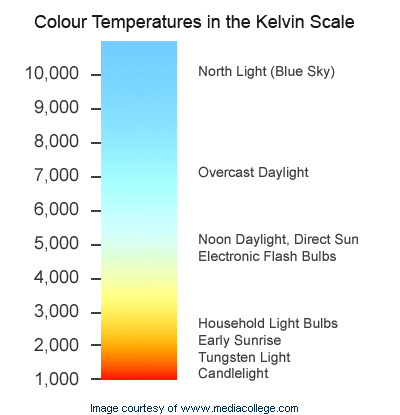
A colour temperature is defined as a characterisation of the spectral properties of a light source and is commonly used during the production phase in the film and photography industries. To simplify things, if the light is a low colour temperature then it will be warmer and a yellow to red colour. Whereas if a light is a higher colour temperature it is cold and more blue.
Colour Temperatures are measured in Kelvins (K)
The main light source that will be found in the short film I am making is an ordinary room light bulb. This will be to keep lighting realistic. The Kelvin measurement for a standard room light bulbs is measured at 2500k.
Secondly for the outdoor scenes, the following measurements can be used; an overcast sky is 10,000 k and outside on a sunny day is roughly 6000 k.
The definition and calculations above where found on the website http://www.webopedia.com/TERM/C/color_temperature.html at 18.10 on Sunday 17th January 2010. The Author was unnamed.

This image was found at : http://www.mediacollege.com/lighting/colour/images/colour-temperature.gif at 18.21 on January 17th 2010, Author unnamed.
By using lighting the job roles I will have are as follows:
- Organising appropriate lighting for each scene
- Designing the lighting in each scene to create the atmosphere for the scene.
- Drawing out a technical recce as well as a thorough risk assessment
The main lighting used in the film, is just forward key lighting which will illuminate the characters. It will only be this lighting to keep scenes naturalistic.
Each day of my film starts in either the kitchen or bedroom of the character Amelia. Using lighting I will make it appear as though it is early morning, this will be accomplished with blue gels, to give the look of a dreary early morning.
However, in the evenings when Amelia is alone, working in her bedroom a thin red gel will be used to connote anger and frustration. Each evening the red will get stronger to reveal her inner mind and how she is feeling. For shots at school, no gels are needed, as the natural lighting from filming during the day will be accomplished. Furthermore, by not using gels it allows the school to have neutral tones. That will therefore show, that her mornings are calm (blue gel), her days are neutral (no gel) and in the evening she begins to get frustrated (red gel), which connotes how she is feeling.
Each day of my film starts in either the kitchen or bedroom of the character Amelia. Using lighting I will make it appear as though it is early morning, this will be accomplished with blue gels, to give the look of a dreary early morning.
However, in the evenings when Amelia is alone, working in her bedroom a thin red gel will be used to connote anger and frustration. Each evening the red will get stronger to reveal her inner mind and how she is feeling. For shots at school, no gels are needed, as the natural lighting from filming during the day will be accomplished. Furthermore, by not using gels it allows the school to have neutral tones. That will therefore show, that her mornings are calm (blue gel), her days are neutral (no gel) and in the evening she begins to get frustrated (red gel), which connotes how she is feeling.
To achieve the best sound quality when filming, microphone booming will be used. Booming is when the microphone is attached to a long pole (called a boom pole) of between12 and 18 feet by a shockmount. The person controlling the boom is called the "Boom Operator". The shock mount is holds the mic in a rubber band mechanism which stops vibration from travelling up the pole to the mic. This could alter the sound.
The Boom Operator which will be me, has to hold the pole either above or below the actors to record their sound. To hear adequately I must wear headphones, to detect any background noise which is interfering with the sound. With booming comes "The Rule Of The Thumb" which means that the boom must be as close to the actors as possible without being seen in the film. As the further away from the intended sound the more background noise will get in which will interfere. The mic is usually held a minimum of two feet above the head, however if this area is obstructed booming from below may be used. Booming allows several actors voices to be recorded which makes it a favoured technique.However, when using the mic from below the sound will not be as clear and sound more bassy as it picks up sound from the chest cavity. Furthermore, as the mic is closer to the hands any noise made from hand gestures will be picked up and may go over dialogue.
We will be using Booming in our film, as firstly it is the equipment made available to us and secondly it is referred as the most favoured technique for its ability to record dialogue well. There are two different ways of holding a boom: by being attached to a large pole, or by pistol gripping. 

When attached to the pole, the boom can be held up above the actors when they are talking, which allows the camera to get a wide angle shot without seeing the boom. Sometimes the microphone however, may be used via Pistol Grip (See Right), which is when the pole is taken off and just the Microphone is used as a hand held. This can be easier as it is not as heavy and therefore easier on filming longer scenes. This type of booming can only be used on close up scenes which do not contain too much dialogue, as the Boom always needs to be close to the dialogue speaker.
This is the outside casing which holds the microphone. The casing is referred to as a Modular Windshield, it surrounds the microphone protecting it, as well as preventing any unwanted wind sounds.

 Filming outdoors requires a boom Windjammer, the Windjammer is a synthetic fur cover which stops wind from interrupting sound. Inside the Windjammer is the modular windshield which holds the Mic. The Mic is held inside a Modular suspension which cradles the Mic precenting any interruption from sound waves or vibrations.
Here is the Modular Suspension; this holds the microphone in place inside the basket. It allws the microphone to stay still which protects it from damage as well as allowing perfect sound.

Information found on http://www.rycote.com/products/families/ 18th March 2010
Our Marketing Plan - Individual
Marketing Strategies
What is a screening?
A screening is described as a displaying of a movie/motion picture.
Definitions
Stills and Postcards
Stills/postcards should be a striking, high resolution still image in bith portrait and landscape forms. This postcard will be a small poster which will be the main image that will publicise the film. To add to this, an image with text about the film could be around it, as well as shots from filming and the actors. These pictures and images, can then be passed out at festivals and even e-mailed to the press. If the movie has a website, it should be on there and possibly to download.
For the image to be more attractive, to make more people look at it, the image should be as striking and colourful as possible. As it will make it more likelier to appear in festival catalogues. This memorable image will be more likely to stick into peoples minds and make the film more memorable.
The most effective shots are usually close up headshots. If the poster is likely to offend anyone or be controversial, people will not want it in magazines or festival catalogues.
Tapes/DVD
For extra security there should definitely be more than one copy of the film. To enable any recipients of your film to watch it, a variety of formats should be used. E.g. QuickTime, DigiBeta, Beta SP, MiniDv and so on. Otherwise if the film is delivered and people are unable to view it, it is doubtful that they will contact you to tell you it is not working. Therefore it will go unwatched.

On the DVD it should be well labelled with:
Title
Length
Contact details
Aspect ratio e.g. 16:9 or 4:3
When labelling the dvd , it is better to use a marker pen than a sticker as stickers can sometimes interfere and make the DVD not work.
If the film is shown on a website online, the URL of the site could be placed on the back of the postcard, which is then handed out at film festivals.
Showreel
A Showreel is a approximately two minutes long edited montage of the film.

Film Prints
Many distributors prefer to have access to a 35mm print master, as this is referred as the easiest to format. The format that is generally asked for is NTSC rather than PAL.
Press Kit
A press kit should contain:
Film title inc Directors name
Cast and Crew list (everybody should be credited)
Length of the film
Year film was produced
Original Format
Country of origin
Synopsis
Logline
Funding and production details
Useful URLS
Copyright Details
Producer/Director contact details
Trailers and Clips
A trailer should be around a 30 second cut from the film which can be used to promote the movie online. This can be through social networking or the films actual website.
Websites
Creating a website is a very useful technique in creating films. All films now generally have websites, with teasers and posters. The website can be advertised in attracting potential viewers. If blogging is used, it can be an excellent way of gaining feedback about the movie. As well as acting as an online portfolio of the work that has been put together.
On the website, all cast and crew info should be found as well as stills from the movie.
Individual Marketing Strategy
Stills and Postcards
Stills from the movie itself, will be used to distribute the film, as well as the making of. This will give consumers an inside look at how the film was made. However before this, the postcard sized posters will be released. The postcards will have the URL of the video’s website in the space in which the address is usually put. This can then be cheaply handed out at film festivals and among peers to help spread the message of the film. To keep suspense, the URL will only lead to the trailer rather than the whole film.
Tapes and DVD’s
A standard DVD will be e-mailed to festivals, as e-mailing in different formats could possibly be risky, though creating DVD’s may be costly, In this case, the URL of the video or trailer could be e-mailed, which will cut costs significantly.
Showreel
The Showreel appears to be an interesting idea. A montage of images from the film would be entertaining. As the film itself is a drama, stills from filming, when actors are enjoying themselves and cast and crew are laughing, could help spread a more positive side to the film. To show even though the film conveys an important message, it was an enjoyable experience to make.
Press Kit
The Press Kit will contain all the information needed to be sent along with the DVD. As a simple spreadsheet of data will be dull, a more interesting way could be used as a format; Perhaps small postcards with information, with an image on one side and the info on the other.
Trailers and Clips
Trailers and Clips will be created to put on the website as a way of publicising the film so that people want to see more.
Websites
Two websites will be created for the film. On the first website will be exclusive official trailers, clips and stills from the movie to publicise its release. The second website will be a social networking site page on FaceBook. Which people will be able to join to find teasers and upcoming release dates.
Film Festivals

East is East Distribution
East is East is a based upon a proud Pakistani chip shop owner married to a white woman and having seven children, enforcing his strict religious rules upon them. However living in England has made them more and more British than he will allow. East is East was originally shown in theatres in 1996 in Birmingham then went to big screen and released into the cinemas after previews, Friday 5th November in 1999 on just 79 screens.
 It was only after three weeks that the film actually went wide and showed onto 246 screens. East is East then slowly staggered onto more screens (253-280).Directed by Damien O’Donnel. The reason for East is East’s staggered release is due to its lack of commercial potential, earning more and more for its first five weeks, which is rare as in most common cases films will do their best in the first three days. However, due to East is East’s positive word of mouth, more and more consumers went to see it, which would have made it a sleeper hit, as it wasn’t expected to do well. Otherwise it would have been shown on 400 screens alike every other movie premier.
The story was written by Ayub Khan-Din who gained his story ideas from his own family stating in an interview “the parents are drawn directly from my own family” He then goes on to explain the youngest child is based upon himself and many of the ideas and arguments are from childhood memories. Having the story almost auto-biographic would have made it seem all the more realistic as Khan-Din is able to relate to his own experiences – something he will know better than anybody else. This shows that his story was clear from the start.
East is East was distributed from Assassin films gaining most of its finance from FilmFour whose clever distribution and reputation was able to get East is East into cinemas. The film was considered a low budget comedy having a 1.9 million budget, then taking in over 10 million and a further £12,300,000 in rentals, Therefore, showing the power of British comedy. East is East had both positive and negative responses; from receiving a BAFTA to being banned in Egypt. East is East also showed in America with Miramax as their distributor whom made an obscured poster which showed a blonde white female with Asian characters seen in windows above her face.
East is East PR objective was: “To position “East is East” in the media and in the public domain as a must-see, hugely successful, critically praised, hip, British comedy for all and everyone to enjoy” East is East was successful not only due to its comedy factor, it appealed to a range of cultures as it emphasised the universality of family problems with a risqué twist. This was sure to be a hit with young adults as well as teenagers. East is East advertised in several magazines which aimed at; Teens, Women, Men, Film enthusiasts, Music magazines and student press, which would have targeted everybody with perhaps the exception of older generations. However the advertising on Radio and television would have caught a majority of peoples attention, which would have targeted every age group. As the theme of the story is family, East is East was targeted at every generation as each generation has a character to relate to. As well as each ethnicity due to its multi-cultural themes.
In conclusion, East is East was originally expected to be an average British film based on a multi-cultured family in the 70’s. However with excellent word of mouth it was able to be just as successful in terms of profit as Fight Club which had a budget of over 63 million, released the following week. Though Fight Club had higher revenue by millions, it also had a budget and cast East is East would never have been able to use. Nevertheless despite having The Blair Witch Project, The Sixth Sense and Fight Club released at similar times didn’t stop East is East being more successful than imaginable. Though the distribution was quite average; magazines and television, it had no unique ideas (e.g. Blair Witches internet viral campaign) which would have helped push it to the top therefore showing it was the story itself that sold the movie. As the actors were not particularly well known, which was a selling point for The Sixth Sense and Fight Club (having Bruce Willis and Brad Pitt) East is East had to work with unknown actors. Had East is East had a higher budget and better known actors it is possible to say it may have done better however as it was a English comedy originating from the theatre perhaps it would have done no better had any more money be put into it.
Analysis of Film Posters

Film Posters
Film Posters, all aim to do the same thing; attract people, make people want to see the movie. Therefore the most common attributes to a film poster will be:
Film Posters, all aim to do the same thing; attract people, make people want to see the movie. Therefore the most common attributes to a film poster will be:
- The actors and/or a reoccurring or specific image from the film
- Actor and Actresses names
- Release date
- Production companies involved
- An integral quote from the movie itself
However some movies work slightly differently, usually horror or disaster movies especially. They will release a Poster which has limited information. As an example we can look at Cloverfield, which released just a picture and its date, without any information at all. This intrigued audiences to find more which led to Cloverfields great marketing campaign that kept its audience always wanting to find more. Slowly more and more posters came out with more details about the film, e.g. its name and quote about the film itself.
Film posters are one of the main things used in the distribution process to advertise a film, therefore it is crucial that it works in line with the film. After looking at several film posters, you can see that the type of film is represented in its poster. If you look at action films such as The Matrix and Mission Impossible 2 they both show significant images from the films e.g. guns and fire. This therefore shows the audience the films are action films. Whereas teen classics such as Pretty in Pink and The Girl Next Door show teens with usually anguished facial expressions, this tells the audience that the film will feature distressed teenagers, something teens can relate to. This is important to my film as it will feature a teenage girl who is going through the toughest time of her childhood, its ending. Therefore I could use the actress and ask her to act out how the character is feeling at the films lowest point, which will represent the films theme. However, given the films title; Toast a quirky alternative name, which intrigues the audience, perhaps the Poster should be the same. In conclusion of my problem, three draft posters will be made.
Close Analysis of film posters

Notting Hill was a hit in 1999, written by Richard Curtis and directed by Roger Michell. It was the actors and reputation of Richard Curtis and not the poster which probably sold the film. Therefore though the analysis may find a few conventions of a film poster, it will not display how to distribute a film effectively. I used this poster as like my film it is British, however the similarities stop there. From this poster we get the overall impression that the female is out of reach of the male, as she herself is a large poster. Thus we get the idea of the film. The age of the actors also tells us the main target market for the film. As generally audiences tend to watch films about their own age group. The Poster also shows the title and names of the actors, therefore creating no suspense about the film itself, it is fairly self explanatory that it is a rom-com. Below the title all other actors and members of the main cast and crew as will as distributing companies are listed. Furthermore, we can also see the quote "Can the most famous film star in the world fall for a man on the street?"This right there is telling the audience what the film is about in one sentence. And lastly on the bottom of the poster it states that the film has the same creators as Four Weddings And A Funeral, which also tells the audience, if they liked those films then they may like this one. All in all this is a generic film poster that tells the audience everything they need to know about the film at a glance.
Image was found from
http://wpcontent.answers.com/wikipedia/en/thumb/3/38/NottingHillRobertsGrant.jpg/200px-NottingHillRobertsGrant.jpg


Kidulthood was released in 2006 and was a hit in Britain especially among teenagers. Probably due to its characters audience could easily relate to and bold storyline based around the every day lives of troubled working class London teenagers. Kidulthood was written by Noel Clark and directed by Menhaj Huda The first thing about this poster that stands out is the characters, to put it simply they all appear dangerous. This is due to their angered expressions and largely in part due to the baseball bat held above one characters shoulder in a threatening manner. Secondly is its title which connotes many things; firstly is the obvious play on words and its idea that there is a specific time period when your not a child or adult yet. Put that with the quote "before adulthood comes Kidulthood" and the general storyline of the film is given. The audience can tell it is pre-adulthood teens struggling with gang violence and relationships. Unlike Notting Hill Kidulthood hasn't displayed actors names, perhaps as they are not publicly known yet. This means the actors are not what it selling the film as in Notting Hills case. And lastly is a star rating as well as a quote said about the film, which is clearly a huge selling point, it basically implies the film must be watched. Though my short film is about teenagers, it is actually about a teenager who is of a middle class background and has much less threatening things to worry about, but more daunting things. The pressures of expectations, from teachers, parents and herself. Therefore from this poster I have learnt the value of set design, facial expressions and clothing as they set the theme of the story. Something that both Kidulthood and Notting Hill had was a quote describing the film, which gives the audience an idea of the film in one sentence. I want to do something like this on my poster. As well as a one line review, which could come out of the film review I make for the my film.

This is a poster for Billy Elliot, which was successful in 2000, written by Lee Hall and Directed by Stephen Daldry. The image shows a young boy in a boxing uniform surrounded by ballerinas, though I have seen Billy Elliot and know what it is about, this image is not necessarily very explanatory. Perhaps it is to make the audience want to know more, as the image is more bizarre than those featured above, where the others tell you what it is about this one is more interesting. From the top line above the image once again we can see who the creators are, alike Notting Hill they have the same creators which tells the audience if you liked one of these films you may like this. The title however is much smaller underneath the image, which is quite a contrast to Kidulthood. Conceivably because where Kidulthood had quite an interesting and diverse name, Billy Elliot is just a title, and the image speaks more than the title. You can tell that the poster is for a film being released in the cinemas as "This Fall" is placed at the bottom. And around it all actors, cast and crew are listed, so the audience will know exactly who is in the film and who created and distributed it.

Alive in Joburg, was orignally a short film produced in 2005 by Simon Hansen and Directed by Neill Blomkamp. However, 4 years later after is success was released as a feature film with executive production by Peter Jackson. Which would be fair to say the short film was extremely successful. The Poster (right) is fairly simplistic, showing no names of directors, producers or actors. It is unclear whether the man is even a central character in the production. It is made clear that a city is being invaded by large space ships and the military of some sort have got involved. From the title we are given the location of Johannesburg in South Africa. Therefore the audience is identified, which could be any age, but definitely science fiction fans and possibly South Africans. As the film itself, is a representation of the segregation among black and white people which was so apparent before Nelson Mandela's presidency. The font itself connotes masculinity and sci-fi. The fact that no other information is given e.g. Director name, Producer name and Actor names. This, makes the audience want to find out more.
For our groups film poster, we orignally planned to do full A4 to A3 posters. However, we decided due to budgeting and distribution it would be preferable to make small A5 postcard sized posters. Furthermore, this will alow us to distribute the film by sending the postcards, handing them around at film festivals and so on. Therefore, the posters will not only be cheaper, but easily distributed.
Four example Postcard sized Posters will first be drawn up, as a plan before capturing them with film. The four posters will first be described, then once drawn up, taken into analytical detail.
The first Poster
Will be a kitchen table cloth with a white plate and a piece of toast on it with one small chunk taken out. Though it may be a strange idea the reasons behind it are many; firstly the image will represent a consistent image shown throughout the film. Amelia's breakfast which goes forgotten each day as she rushes to school. The tiny bite taken out of it showing Amelia's weak attempt at looking after herself as well as an overall feel for her weak personality. The slice of Toast also represents the idea of Amelia trying to do too much at once and not getting much out of it.

The Second Poster
This Poster will be a still shot from the movie, it will be Amelia lying in bed with her eyes open and make-up smeared down her face. The image on a postcard will make audiences wonder why she looks distraught as she does. Collected with its title; "Toast" will create mystery about what the films plot is.

The Third Poster
Will be an extreme close up of Amelias face. Like the above poster, Amelia will have make up smeared down her face. This will immediatly set the tone for the short film, telling the audience it is a short drama about a teenage girl. The plotline itself will be kept a mystery untill the review or film itself is released.

To understand how to create the back of a postcard I looked at someone else who had done the same idea previously. The post card I took inspiration from was as below. 

This is the first Postcard back I made:

I made the back of my postcard back using Adobe Photoshop. I kept the detail to the minimum, as I wanted to have only the important details on the back. Telling whoever was given the postcard the name and the names of those who created the product. I chose the font 'Pristina' as I wanted the postcard to reflect Amelia. As she is a student of high standards, it would be logical that her handwriting would be extremely neat. Therefore, it is as if she has written the postcards details herself.

However, the postcard seemed too simple and doesn't match with the front, therefore I made another one. This postcard back matches with my UCAS themed poster. By using the font calibri and the same colour scheme (including tinting the background) I created a postcard back that mimics the UCAS website. This postcard back is more in keeping with the theme of Toast, so is the one I am choosing to be my final postcard back.

For my poster I chose to pursue two of my original designs. Deciding that the plate of toast design was too simple and not interesting enough.
The first of my posters is the still shot of Amelia lying in bed. However, to make it more interesting I used the layout of UCAS to create the background. When the target audience (teenagers) sees this they will identify the UCAS background and understand to some extent what the film may be about. To make it more interesting I took, the UCAS logo away and replaced it with the film title Toast. Furthermore, where there is a picture of a man usually in the UCAS picture I replaced it with a picture of Amelia looking with her work. This is the poster I will be using.

The second poster I made, was an extreme close up of Amelia's face after she had been crying. I edited the background by adding piles of books. In research I found that a common poster convention was to have an extreme close up of the central protagonists face. This way the postcard will stand out, which is worth while when entering film fests as the postcards that stand out may be put into the film fest booklet.

Subscribe to:
Comments (Atom)